
 Contact us
Automation
(Last updated: Thursday, April 09, 2026)
Smart Zap EPROM Burner by Micro Kit
My memories
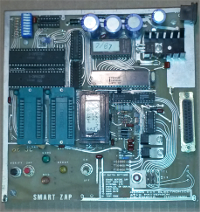
I've had this EPROM burner since 1987, it's been a valuable tool in my various projects. And it still works. So while cleaning up my collection of things and doing some research on the internet I found it odd that there was no mention of it to be found. So with that this page has been created. I do have the source code to the ROM on the burner but since I don't have permission to post it, I won't. But I will post the photos and scans of the rest of the documentation that goes with it.
So it's 1987, I'm in need of a decent and reasonable EPROM burner that can handle all the latest EPROMs and EEPROMs. The 27C256 (32K x 8 bit) was very popular. But 27C64 (8K x 8) was the norm. So one day while reading the Computer Shopper I came across this ad for an EPROM burner kit for less than $100. An excellent price and it even said they'd give you the source code (this was before Open Source, so this was huge). The documentation described putting it together, it was a complete kit (except for a common 12V AC power supply), it used common parts, I'd have the schematic, the API, sample programs to talk to the burner and the source code to the burner if I ever needed to modify it (so far I haven't had to).
An interesting thing about the Computer Shopper. You usually didn't buy it for the articles. Although there were good articles, they only made up a small part of the magazine. You bought it for the ads, and I mainly bought it for the used and surplus computers and electronics tools and parts section. It was size of a normal newspaper and about 2 inches thick during the best of times. I purchased my first soldering iron (a Weller, I still have it), this EPROM burner, tons of Atari software and hardware like disk drives and I even used the BBS section to get local boards. This is how I got my start in electronics and computers. This was at a time when businesses were transitioning from minis to beige box, PCs that ran MS DOS. So a lot of them were dumping their old stuff. You could get a RGB monitor (slightly better than an old color TV) for half the price of a cheap green composite monitor. Those were interesting times.
Taped to the front of my manual is a business card for Micro Kit and it looks similar to this:
  Karl Burdick                       Robert Thomas
  Res: xxx-yyyy                      Res: xxx-yyyy


                     Micro Kit
          Microcontroller Systems Design


  6910 Patterson
  Caledonia, MI 49316                (616) 791-xxxx
The overall kit is relatively simple in design. It's based on an Intel 8031 microcontroller running on a 3.6 MHz crystal, it has 128 bytes of RAM, 8K of ROM (a 2764 EPROM) and 2 8255 PIO chips and the rest is support chips and the power sections. This burner supported a variety of chips including the really odd 25xx EPROMS that used 25vdc to program with. It has 2 interfaces, one parallel port interface (exactly like a printer) and the more common, and slower, RS232. I ran it at 9600 baud. It was flexible in that you could change the programming parameters (usually the timing and pulse methods) to speed up downloading (buring) your code to the EPROM. Without these changes writing to a 27128 (16Kx8) would take about 15 minutes. With the changes it was a couple of minutes. Double the time for a 27256 (32Kx8) and again for a 27512 (64Kx8). An adapter is needed to use the newer 27010 through 27080.
I haven't scanned all the manuals yet, but I will.
Computer Shopper - Micro Kit Smart Zap Ad
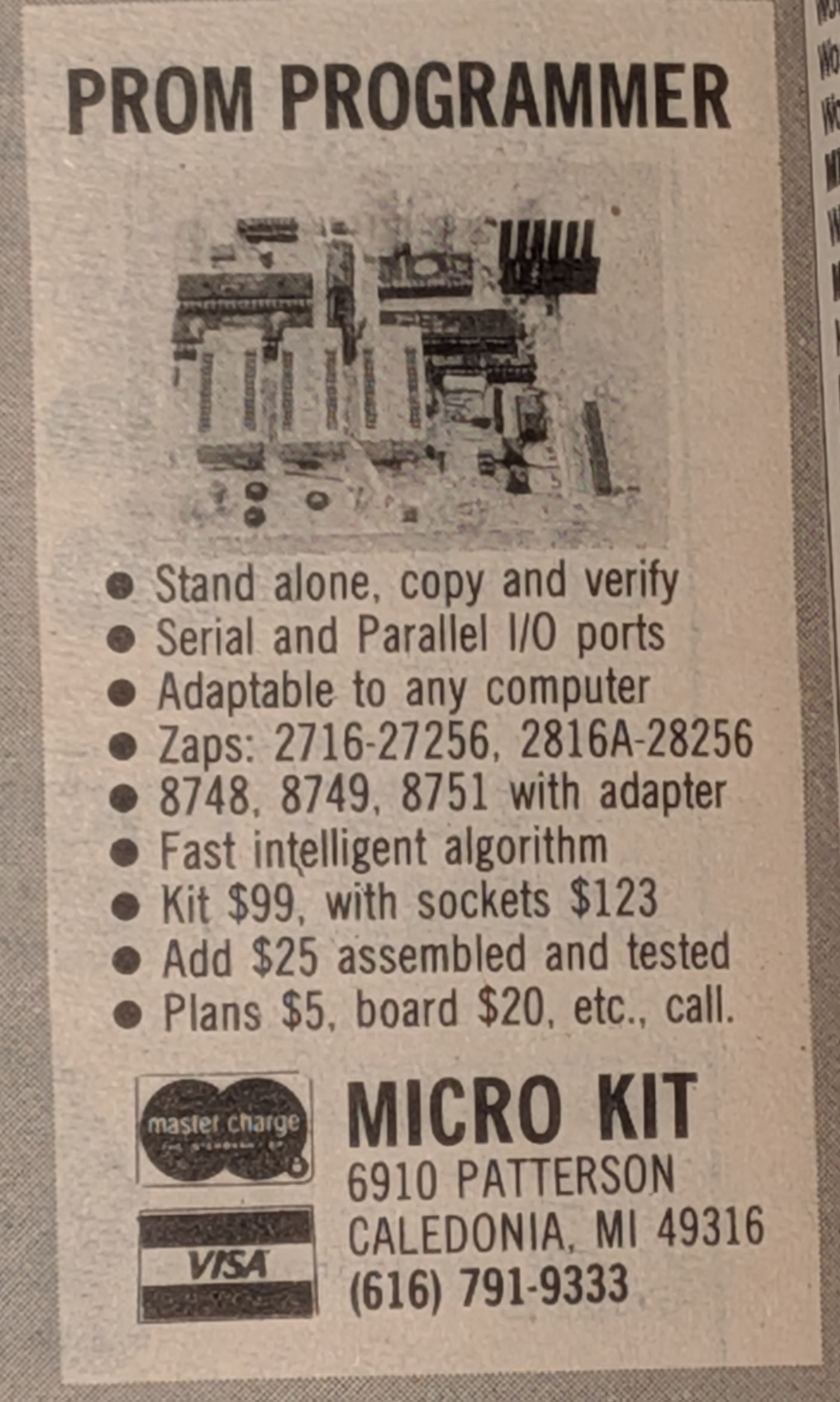
Well I seem to be lucky. I was checking out the back sections of the Februrary 1987 Computer Shopper and found the Micro Kit ad.
Kore SX-151 Smart Zap EPROM Burner
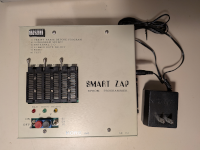
Just got this off Ebay (20260409)
I saw this up on EBay for less that $100. Some other guy is selling another for $799, no idea where he got that outrageous price from. Pretty sure this is a later model of my SmartZap kit above. I opened up the Kore unit and looked inside. It's a different design but uses all the same chips. One difference is that the programming voltage is set by a 3 position switch and there is no parallel port interface. The dip switches mostly have the same settings. So I'm pretty sure that the manual and modules will be close to being the same. I will dump the rom and see how it differs from the one in my burner.
BTW, Kore was out of the same town in Michigan, Caledonia. That's the town listed on my copy of the SmartZap manual. I can't find any additional information on Kore. One day, if I'm lucky I might find a Computer Shopper with the Smart Zap ad in it. That's where I bought the kit.