
 Contact us
Automation
(Last updated: Tuesday, July 08, 2025)
Intel SDK-85 & URDA SDK-85
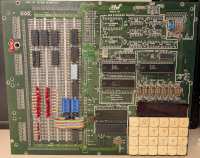
The Intel SDK-85 development board from 1979 (the oldest chip on the board is from 1979, 19th week). After I self taught myself assembly language on my Atari 800xl (and before I had Ominmon XL) I learned 8085 assembly language on the Intel SDK-85. I loved assembly language and until I learned C I did most of my programming in assembly (on the 6502, Atari). I did manage to get myself in trouble for disrupting the class. My friend Armondo and I would get a bit animated (loud) in the back of the class discussing the merits of fast or smaller code. Remember these boards only had 256 bytes of RAM.
The Intel SDK-85, introduced in 1977, was a single-board computer designed to allow engineers to develop products based on the Intel 8085 microprocessor, featuring a 6-digit LED display, a 24-key hexadecimal keyboard, and expandable RAM and ROM. It was also a staple for engineering students at colleges to learn assembly language and interface electronics to a microcomputer.
Intel SDK-85
- Manufacturer: Intel
- Type: Single-board computer
- Release Date: 1977
- Cost at release: USD $250
- Processor: Intel 8085A running at 3 MHz with a 1.3 μs instruction cycle
- Address Range: 64K (typical of most 8 Bit CPUs of the time)
Memory:
- ROM: 2 KB expandable to 4 KB (using 8355 or 8755)
- RAM: 256 bytes expandable to 512 bytes (using 8155)
I/O:
- 38 programmable parallel I/O lines (expandable to 76 lines)
- Serial interface through SID/SOD pins of 8085
- Display: 6-digit 7-segment LED display
- Input: 24-key hexadecimal keyboard
Interfaces:
- TTL-compatible bus
- 20 mA current loop for teletype (110 baud)
URDA SDK-85
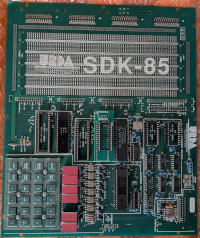
This URDA SDK-85 was an unloved board at the VCF East swap meet. It had been passed around and no one wanted it. So I adopted it, cleaned it up and fixed it. I need to burn the EPROM so it has code on it then I'll build a special 8755 EPROM burner so I can replace the EPROM with the proper 8755. I'll also be adding a 8251 and some RAM so more experimenting can be done with this board.
This SDK-85 appears to have been built in 1987 as that's the latest chips on the board, that I didn't add/replace during the repairs and upgrade.
URDA SDK-85 is very close to the original design of the Intel kits. I'm not sure which revision it is based off of. Most of the information from the Intel manuals has matched what I've found on the URDA SDK-85.
Software and manuals
- Intel SDK-85 Users Manual July 1977
- Intel SDK-85 Users Manual February 1980
- EPROM PROGRAMMER USING SDK-85 by Surendra Pal & R.S.Singh
- SDK-85-EPROM_8755A_v2.1.rar
- Jim Shortz's Github SDK-85 repo (Jim's assets for his Intel SDK-85 projects)
- sdk-85-eprom.pdf (by Jim Shortz)
- sdk-85-expander.pdf
- SDK-85 MONITOR VER 2.1 listing
- sdk85mon-8k.bin - More than just the monitor
- sdk85mon.bin - 2K ROM
- sdk85mon.zip
- sdk-85.tar.gz - collection of lots of SDK-85 related files
- sdk85util.zip - Util ROM for the 2nd 8755
- TESLA-PROMER.ca65.txt (yes that's 6502 code, it's a reference)
- TESLA PROM Programmer Board Schematic.pdf
- Intel SDK-85 Enhancements - Jim Shortz adventures with an Intel SDK-85
- Intel SDK-85 Enhancements - project logs
- Intel SDK-85 8085 System Design Kit - Glitchworks Intel SDK-85 8085 System Design Kit